
|
||||||
|

Fusion gene:CLIC1_HIST1H2BC (FusionGDB2 ID:HG1192TG8347) |
Fusion Gene Summary for CLIC1_HIST1H2BC |
 Fusion gene summary |
| Fusion gene information | Fusion gene name: CLIC1_HIST1H2BC | Fusion gene ID: hg1192tg8347 | Hgene | Tgene | Gene symbol | CLIC1 | HIST1H2BC | Gene ID | 1192 | 8347 |
| Gene name | chloride intracellular channel 1 | H2B clustered histone 4 | |
| Synonyms | CL1C1|CLCNL1|G6|NCC27 | H2B.1|H2B/l|H2BC10|H2BC6|H2BC7|H2BC8|H2BFL|HIST1H2BC|dJ221C16.3 | |
| Cytomap | 6p21.33 | 6p22.2 | |
| Type of gene | protein-coding | protein-coding | |
| Description | chloride intracellular channel protein 1RNCC proteinchloride channel ABPhRNCCnuclear chloride ion channel 27nuclear chloride ion channel proteinp64CLCPregulatory nuclear chloride ion channel protein | histone H2B type 1-C/E/F/G/IH2B histone family, member Lhistone 1, H2bchistone H2B.1 Ahistone H2B.lhistone cluster 1 H2B family member chistone cluster 1, H2bc | |
| Modification date | 20240407 | 20240305 | |
| UniProtAcc | . | . | |
| Ensembl transtripts involved in fusion gene | ENST00000375779, ENST00000375780, ENST00000375784, ENST00000395892, ENST00000383404, ENST00000383405, ENST00000400052, ENST00000400058, ENST00000415179, ENST00000418285, ENST00000420458, ENST00000422167, ENST00000423055, ENST00000423143, ENST00000423804, ENST00000425464, ENST00000431921, ENST00000433916, ENST00000434202, ENST00000435242, ENST00000438708, ENST00000438750, ENST00000442045, ENST00000447338, ENST00000447369, ENST00000451546, ENST00000456863, ENST00000457485, | ||
| Fusion gene scores | * DoF score | * DoF score (Degree of Frequency) = # partners X # break points X # disease types 7 X 7 X 8=392 | * DoF score (Degree of Frequency) = # partners X # break points X # disease types 2 X 2 X 3=12 |
| # samples | 9 | 3 | |
| ** MAII score | ** MAII score (Major Active Isofusion Index) = log2(# samples/DoF score*10) log2(9/392*10)=-2.12285674778553 possibly effective Gene in Pan-Cancer Fusion Genes (peGinPCFGs). DoF>8 and MAII<0 | ** MAII score (Major Active Isofusion Index) = log2(# samples/DoF score*10) log2(3/12*10)=1.32192809488736 effective Gene in Pan-Cancer Fusion Genes (eGinPCFGs). DoF>8 and MAII>0 | |
| Context | PubMed: CLIC1 [Title/Abstract] AND HIST1H2BC [Title/Abstract] AND fusion [Title/Abstract] | ||
| Most frequent breakpoint | CLIC1(31701342)-HIST1H2BC(26115363), # samples:1 | ||
Top |
Fusion Gene Breakpoints for CLIC1_HIST1H2BC |
| RNA-seq based exon junction arranged fusion gene breakpoints from 8 resources (TCGA, CCLE, cBioPortal, GenBank, ChimerDB, ChimerKB, ChildHoodFusions, and GTEx). For the expressed sample information, go to Fusion Gene Sample section. |
| Hgene | Hchr | Hbp | Tgene | Tchr | Tbp |
| CLIC1 | chr6 | 31701342 | HIST1H2BC | chr6 | 26115363 |
| CLIC1 | chr6 | 31701343 | HIST1H2BC | chr6 | 26115363 |
| DNA-seq based exon junction arranged fusion gene breakpoints from dbVar. For the expressed sample information, go to Fusion Gene Sample section. |
| Hgene | Hchr | Hbp | Tgene | Tchr | Tbp | SV type |
Top |
Tumorigenic MoA (Mechanism of Action) Scenarios of Fusion Genes for CLIC1_HIST1H2BC |
| To generate these tumorigenic scenario annotations, we implemented a deduction-first, retrieval-later computational framework. The pipeline first applies rule-guided reasoning across ten core mechanistic categories (M1–M10) derived from fusion gene biology to infer candidate mechanisms, tumorigenic scenarios, targeting points, and targeting backgrounds. To ensure empirical accountability, a governed Python workflow retrieves literature candidates via NCBI E-utilities and Europe PMC using tiered searches. Using JSON Schema-constrained LLM evidence judges (GPT-5.6 Luna and Terra), retrieved articles are evaluated for specificity and confidence without de novo PMID generation. This produces two distinct versions: a strict version restricted to high- or medium-confidence fusion-specific evidence, and an extended version incorporating broader gene-, pathway-, and contextual evidence. |
| Constitutively Active Kinases, Catalytic Domain Dysregulation, & Transmembrane Ligand Fusions | Aberrant Chimeric Transcription Factor / Fusion Transcription Factor Activity | Epigenetic Reprogramming / Histone Modifier Dysregulation | Chromatin Remodeling Dysregulation | Condensate-Driven Transcriptional Rewiring / LLP | Promoter / Enhancer Hijacking | Dominant-Negative Antagonism | Cell Cycle / Checkpoint Bypass / RNA Processing Dysregulation | Subcellular Mislocalization / Spatial Dysregulation | Nuclear Body / Sub-organellar Architecture Disruption & Differentiation Blockade |  |  |  |  |  |  |  |  |  |  |
* Strict version: Restricted to high- or medium-confidence fusion-specific evidence.
| Fusion Gene Name | Mechanism Category | Mechanism PubMed | Tumorigenic Scenarios | Tumorigenic Scenario PubMed | Targeting Points | Targeting PubMed | Mechanism Background | Mechanism Background PubMed |
* Extended version: Includes all strict-level fusion evidence plus broader gene-, pathway-, and low-confidence contextual evidence.
| Fusion Gene Name | Mechanism Category | Mechanism PubMed | Tumorigenic Scenarios | Tumorigenic Scenario PubMed | Targeting Points | Targeting PubMed | Mechanism Background | Mechanism Background PubMed |
| Main function of each fusion partner protein. (from UniProt) |
| Hgene | Tgene |
| . | . |
| Gene ontology of each fusion partner gene with evidence of Inferred from Direct Assay (IDA) from Entrez |
| Partner | Gene | GO ID | GO term | PubMed ID |
| Hgene | CLIC1 | GO:0006821 | chloride transport | 9139710 |
| Tgene | HIST1H2BC | GO:0002227 | innate immune response in mucosa | 12860195 |
| Tgene | HIST1H2BC | GO:0019731 | antibacterial humoral response | 12860195 |
| Tgene | HIST1H2BC | GO:0050830 | defense response to Gram-positive bacterium | 12860195 |
| Tgene | HIST1H2BC | GO:0061844 | antimicrobial humoral immune response mediated by antimicrobial peptide | 12860195 |
Top |
Fusion Genomic Features for CLIC1_HIST1H2BC |
| FusionAI prediction of the potential fusion gene breakpoint based on the pre-mature RNA sequence context (+/- 5kb of individual partner genes, total 20kb length sequence) of In-frame fusion genes. FusionAI is a fusion gene breakpoint classifier based on convolutional neural network by comparing the fusion positive and negative sequence context of ~ 20K fusion gene data. From here, we can have the relative potentency of the 20K genomic sequence how individual sequnce will be likely used as the gene fusion breakpoints. |
| Hgene | Hchr | Hbp | Hstrand | Tgene | Tchr | Tbp | Tstrand | 1-p | p (fusion gene breakpoint) |
| CLIC1 | chr6 | 31701342 | - | HIST1H2BC | chr6 | 26115363 | - | 2.29e-03 | 9.98e-01 |
| FusionAI prediction of the potential fusion gene breakpoint based on the pre-mature RNA sequence context (+/- 5kb of individual partner genes, total 20kb length sequence) of 5UTR-3CSD fusion genes (N-truncated cases). |
| Hgene | Hchr | Hbp | Hstrand | Tgene | Tchr | Tbp | Tstrand | 1-p | p (fusion gene breakpoint) |
| FusionAI prediction of the potential fusion gene breakpoint based on the pre-mature RNA sequence context (+/- 5kb of individual partner genes, total 20kb length sequence) of 5CDS-3UTR fusion genes (C-truncated cases). |
| Hgene | Hchr | Hbp | Hstrand | Tgene | Tchr | Tbp | Tstrand | 1-p | p (fusion gene breakpoint) |
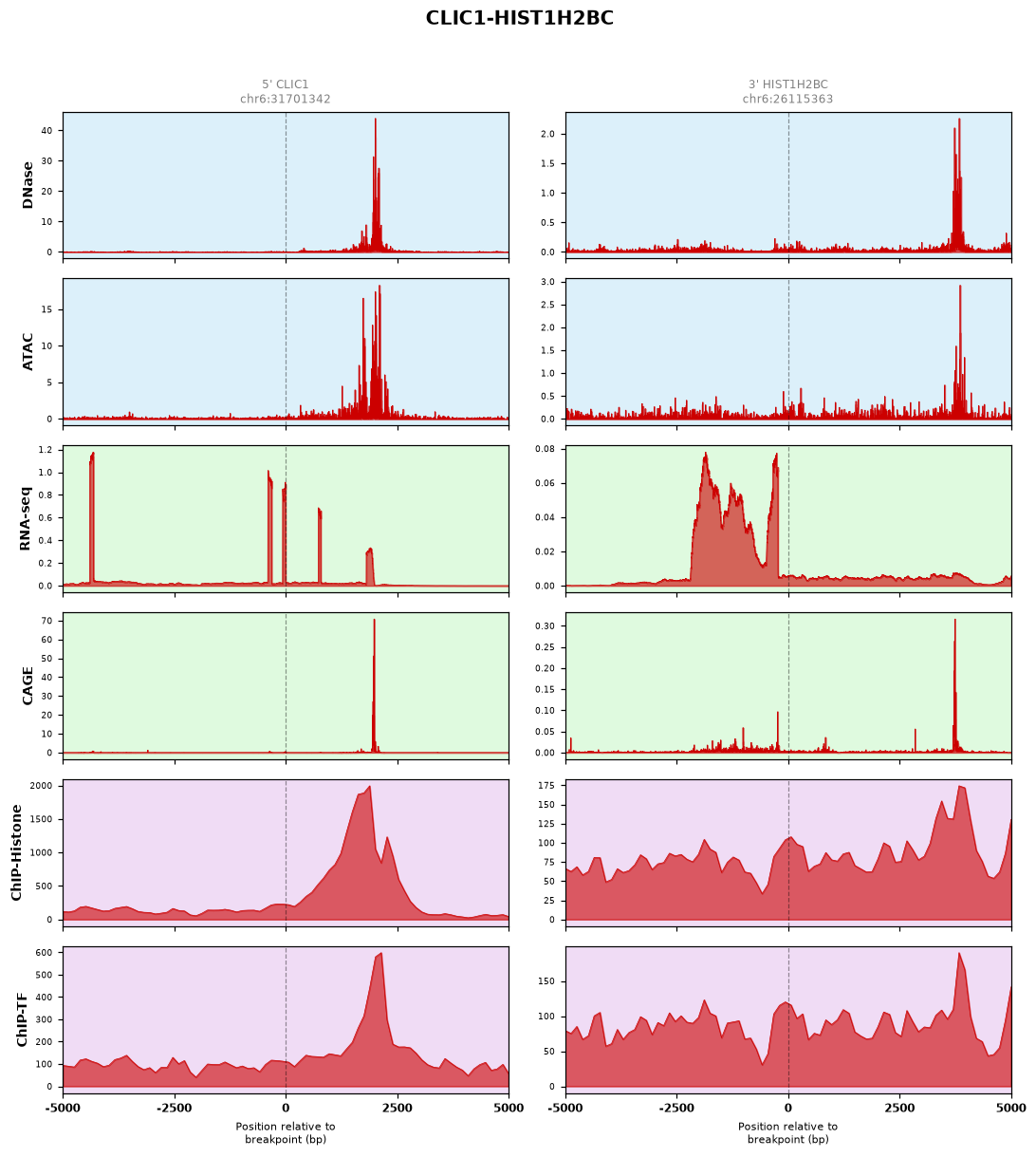
| Distribution of six genomic regulatory feature tracks across a ±5 kb window centered on the fusion breakpoints. We input the breakpoint sequences into AlphaGenome and obtained predicted genome tracks at single-base-pair resolution for each modality by running a single forward pass over the reference sequence. Specifically, for each breakpoint, AlphaGenome processed and returned predicted track data across diverse modalities, which were then averaged across all tracks within each output type and visualized across the ±5 kb window. The left panel shows the 5'-gene breakpoint ±5 kb area, and the right panel shows the 3'-gene breakpoint area, with tracks grouped by category: chromatin accessibility (DNase-seq, ATAC-seq), active transcription (RNA-seq, CAGE), and chromatin binding (ChIP-Histone, ChIP-TF). |
 |
Top |
Fusion Gene ORF Annotations for CLIC1_HIST1H2BC |
| Open reading frame (ORF) analsis of fusion genes based on Ensembl gene isoform structure. * Click on the break point to see the gene structure around the break point region using the UCSC Genome Browser. |
| ORF | Henst | Tenst | Hgene | Hchr | Hbp | Hstrand | Tgene | Tchr | Tbp | Tstrand |
| 5CDS-3UTR | ENST00000375779 | ENST00000314332 | CLIC1 | chr6 | 31701342 | - | HIST1H2BC | chr6 | 26115363 | - |
| 5CDS-3UTR | ENST00000375780 | ENST00000314332 | CLIC1 | chr6 | 31701342 | - | HIST1H2BC | chr6 | 26115363 | - |
| 5CDS-3UTR | ENST00000375784 | ENST00000314332 | CLIC1 | chr6 | 31701342 | - | HIST1H2BC | chr6 | 26115363 | - |
| 5CDS-3UTR | ENST00000395892 | ENST00000314332 | CLIC1 | chr6 | 31701342 | - | HIST1H2BC | chr6 | 26115363 | - |
| ORFfinder Result Based On The Fusion Transcript Sequences of the In-frame Fusion Genes. |
| Henst | Tenst | Hgene | Hchr | Hbp | Tgene | Tchr | Tbp | Seq length (transcript) | Seq length (peptide) |
| ORFfinder Result Based On The Fusion Transcript Sequences of the 5UTR-3CDS Fusion Genes for N-Truncated Protein Search. |
| Henst | Tenst | Hgene | Hchr | Hbp | Tgene | Tchr | Tbp | Seq length (transcript) | Seq length (peptide) |
| ORFfinder Result Based On The Fusion Transcript Sequences of the 5CDS-3UTR Fusion Genes for C-Truncated Protein Search. |
| Henst | Tenst | Hgene | Hchr | Hbp | Tgene | Tchr | Tbp | Seq length (transcript) | Seq length (peptide) |
| DeepORF Prediction of The Coding Potential Based on The Fusion Transcript Sequence of In-frame Fusion Genes. DeepORF is a Coding Potential Classifier Based on Convolutional Neural Network by Comparing the Real Ribo-seq Data. If the No-coding Score < 0.5 and Coding Score > 0.5, Then The In-frame Fusion Transcript is Predicted as Being Likely Translated. |
| Henst | Tenst | Hgene | Hchr | Hbp | Tgene | Tchr | Tbp | No-coding score | Coding score |
| DeepORF Prediction of The Coding Potential Based on The Fusion Transcript Sequence of 5UTR-3CDS Fusion Genes (Potential N-Truncated Proteins). |
| Henst | Tenst | Hgene | Hchr | Hbp | Tgene | Tchr | Tbp | No-coding score | Coding score |
| DeepORF Prediction of The Coding Potential Based on The Fusion Transcript Sequence of 5CDS-3UTR Fusion Genes (Potential C-Truncated Proteins). |
| Henst | Tenst | Hgene | Hchr | Hbp | Tgene | Tchr | Tbp | No-coding score | Coding score |
| ENST00000375779 | ENST00000314332 | CLIC1 | chr6 | 31701342 | HIST1H2BC | chr6 | 26115363 | 0.00e+00 | 3.11e-01 |
| ENST00000375780 | ENST00000314332 | CLIC1 | chr6 | 31701342 | HIST1H2BC | chr6 | 26115363 | 0.00e+00 | 3.90e-01 |
| ENST00000375784 | ENST00000314332 | CLIC1 | chr6 | 31701342 | HIST1H2BC | chr6 | 26115363 | 0.00e+00 | 2.30e-01 |
| ENST00000395892 | ENST00000314332 | CLIC1 | chr6 | 31701342 | HIST1H2BC | chr6 | 26115363 | 0.00e+00 | 2.87e-02 |
Top |
Fusion Protein Retained/Non-Retained Functional Features for CLIC1_HIST1H2BC |
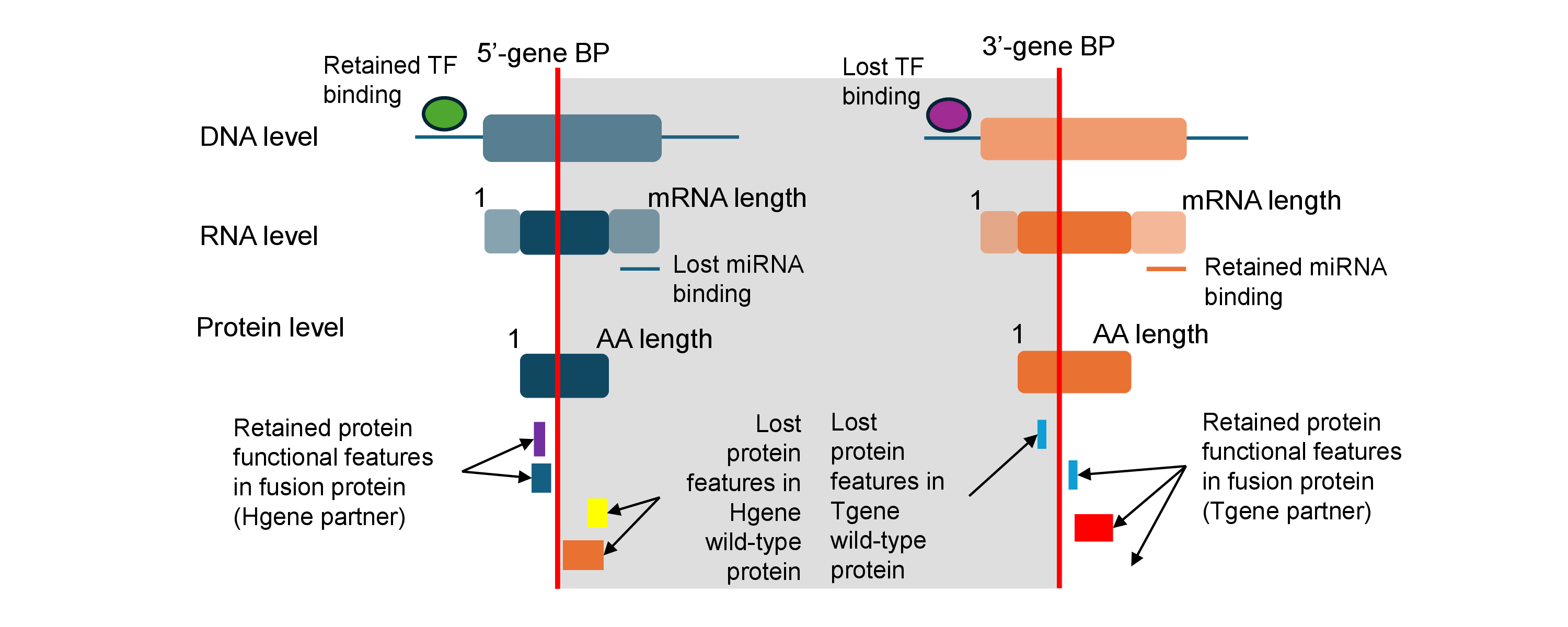
| Protein Level Annotation from FGviewer * Retention analysis result of each fusion partner protein across 39 protein features of UniProt such as six molecule processing features, 13 region features, four site features, six amino acid modification features, two natural variation features, five experimental info features, and 3 secondary structure features. Here, because of limited space for viewing, we only show the protein feature retention information belong to the 13 regional features. All retention annotation result can be downloaded at download page. Minus value of BPloci means that the break pointn is located before the CDS. |
 |
| - View each breakpoint in FGviewer (DNA, RNA and protein levels; GRCh37). If you use FGviewer, please cite: Kim P, Yiya K, Zhou X. FGviewer: an online visualization tool for functional features of human fusion genes. Nucleic Acids Res. 2020;48(W1):W313-W320. doi:10.1093/nar/gkaa364 |
| Data | Hgene | Hchr | Hbp | Tgene | Tchr | Tbp | FGviewer |
| RNA-seq | CLIC1 | chr6 | 31701342 | HIST1H2BC | chr6 | 26115363 | View |
| RNA-seq | CLIC1 | chr6 | 31701343 | HIST1H2BC | chr6 | 26115363 | View |
| - In-frame and retained protein feature among the 13 regional features (visualization across fusion protein length). |
| No matching images found for ${hg}_${tg}. |
| - In-frame and retained protein feature among the 13 regional features (texts). |
| Partner | Gene | Hbp | Tbp | ENST | Strand | BPexon | TotalExon | Protein feature loci | *BPloci | TotalLen | Protein feature | Protein feature note |
| - In-frame and not-retained protein feature among the 13 regional features. |
| Partner | Gene | Hbp | Tbp | ENST | Strand | BPexon | TotalExon | Protein feature loci | *BPloci | TotalLen | Protein feature | Protein feature note |
| - Retained PPIs in in-frame fusion. |
| Partner | Hgene | Hbp | Tgene | Tbp | ENST | UniProt | Strand | BPexon | TotalExon | Protein feature loci | *BPloci | TotalLen | Still interaction with |
| - Lost PPIs in in-frame fusion. |
| Partner | Hgene | Hbp | Tgene | Tbp | ENST | UniProt | Strand | BPexon | TotalExon | Protein feature loci | *BPloci | TotalLen | Interaction lost with |
Top |
Fusion Transcript Sequence for CLIC1_HIST1H2BC |
| In-frame Fusion Transcript Sequences. |
| N-Truncated Transcript (5UTR-3CDS) Sequences |
| C-Truncated Transcript (5CDS-3UTR) Sequences |
>CLIC1_HIST1H2BC_ENST00000375779_ENST00000314332_31701342_26115363 length=522nt Breakpoint=522aa CTCCCCAGGTTCAGGGCGGGGCCGGTCGGGACAGCCCTGGGTCTAGGGGAGAGAGTCCCTGAGTGTGAGACCCGCCTTCCCCGGTCCCAGCCCCTCCCAGTTCCCCCAGGGACGGCCACTTCCTGGTCCCCGACGCAACCATGGCTGAAG AACAACCGCAGGTCGAATTGTTCGTGAAGGCTGGCAGTGATGGGGCCAAGATTGGGAACTGCCCATTCTCCCAGAGACTGTTCATGGTACTGTGGCTCAAGGGAGTCACCTTCAATGTTACCACCGTTGACACCAAAAGGCGGACCGAGA CAGTGCAGAAGCTGTGCCCAGGGGGGCAGCTCCCATTCCTGCTGTATGGCACTGAAGTGCACACAGACACCAACAAGATTGAGGAATTTCTGGAGGCAGTGCTGTGCCCTCCCAGGTACCCCAAGCTGGCAGCTCTGAACCCTGAGTCCA ACACAGCTGGGCTGGACATATTTGCCAAATTTTCTGCCTACATCAAGAATTCAAACCCAGCACTCAATGACA >CLIC1_HIST1H2BC_ENST00000375780_ENST00000314332_31701342_26115363 length=955nt Breakpoint=955aa CCAAGTAGCTGGGATTACAGGTGCCCACCACCCCGCCTGGCAAATTTTTGTATTTTTAGTAGAGACAGGGTTTCACCATGTTGGCCAGTCTGGTCTTGACTCCCTGACCTCAGGTGATCCACCCCCCTTGGCCTCCTAAAGTGTTGGGAT TACAGGCGTGAGCCACCTCACCCGGCCCCTAACTCTATTTCCTATGCCCAATCCCAAGTGTAGGCCACAAGGACTGCAAGTCCTAGTGCTGAGCTGGGCCCGGAGACAGTAGACTGCGGGGGGCACAGGACCTACTGAGACACCAGTCTG GGCAGCTCAGGGAGTGCTGGCGTCACCCCTTCCCTAATCCCAGGCTGCATGGCTAACGGTTCCTATCTGCAGTCCCAGCCTTCCACTTCCGAGTTCTTCTCTCAGACCACAGTCCCAGCAACCCAGAATTTGGATTGGAGTCTGGAAGAA ATGCAGAATGATTAAACGACCACCTTTCCATTTGAAGTCCCCATCCCTGAATCTTCACGGGTGTGCCCAAGCTCCCCTCCCAGTTCCCCCAGGGACGGCCACTTCCTGGTCCCCGACGCAACCATGGCTGAAGAACAACCGCAGGTCGAA TTGTTCGTGAAGGCTGGCAGTGATGGGGCCAAGATTGGGAACTGCCCATTCTCCCAGAGACTGTTCATGGTACTGTGGCTCAAGGGAGTCACCTTCAATGTTACCACCGTTGACACCAAAAGGCGGACCGAGACAGTGCAGAAGCTGTGC CCAGGGGGGCAGCTCCCATTCCTGCTGTATGGCACTGAAGTGCACACAGACACCAACAAGATTGAGGAATTTCTGGAGGCAGTGCTGTGCCCTCCCAGGTACCCCAAGCTGGCAGCTCTGAACCCTGAGTCCAACACAGCTGGGCTGGAC ATATTTGCCAAATTTTCTGCCTACATCAAGAATTCAAACCCAGCACTCAATGACA >CLIC1_HIST1H2BC_ENST00000375784_ENST00000314332_31701342_26115363 length=649nt Breakpoint=649aa CAGGTTCAGGGCGGGGCCGGTCGGTGAGTCAGCGGCTCTCTGATCCAGCCCGGGAGAGGACCGAGCTGGAGGAGCTGGGTGTGGGGTGCGTTGGGCTGGTGGGGAGGCCTAGTTTGGGTGCAAGTAGGTCTGATTGAGCTTGTGTTGTGC TGAAGGGACAGCCCTGGGTCTAGGGGAGAGAGTCCCTGAGTGTGAGACCCGCCTTCCCCGGTCCCAGCCCCTCCCAGTTCCCCCAGGGACGGCCACTTCCTGGTCCCCGACGCAACCATGGCTGAAGAACAACCGCAGGTCGAATTGTTC GTGAAGGCTGGCAGTGATGGGGCCAAGATTGGGAACTGCCCATTCTCCCAGAGACTGTTCATGGTACTGTGGCTCAAGGGAGTCACCTTCAATGTTACCACCGTTGACACCAAAAGGCGGACCGAGACAGTGCAGAAGCTGTGCCCAGGG GGGCAGCTCCCATTCCTGCTGTATGGCACTGAAGTGCACACAGACACCAACAAGATTGAGGAATTTCTGGAGGCAGTGCTGTGCCCTCCCAGGTACCCCAAGCTGGCAGCTCTGAACCCTGAGTCCAACACAGCTGGGCTGGACATATTT GCCAAATTTTCTGCCTACATCAAGAATTCAAACCCAGCACTCAATGACA >CLIC1_HIST1H2BC_ENST00000395892_ENST00000314332_31701342_26115363 length=592nt Breakpoint=592aa GGATTTGATTGGCGCAGTGGGAAGCCCGCGAGAAGAGGTGGAAGCATTCGAATTACATCAAATTCTGGCAGAGAGAAGTAGTTCTGATCAGAACACTCACACCCCTACTGGGACATGCCCATACCCCTTCGCACTTCTACACACCCCTGA AGACAGAGAGCCCCTCCCAGTTCCCCCAGGGACGGCCACTTCCTGGTCCCCGACGCAACCATGGCTGAAGAACAACCGCAGGTCGAATTGTTCGTGAAGGCTGGCAGTGATGGGGCCAAGATTGGGAACTGCCCATTCTCCCAGAGACTG TTCATGGTACTGTGGCTCAAGGGAGTCACCTTCAATGTTACCACCGTTGACACCAAAAGGCGGACCGAGACAGTGCAGAAGCTGTGCCCAGGGGGGCAGCTCCCATTCCTGCTGTATGGCACTGAAGTGCACACAGACACCAACAAGATT GAGGAATTTCTGGAGGCAGTGCTGTGCCCTCCCAGGTACCCCAAGCTGGCAGCTCTGAACCCTGAGTCCAACACAGCTGGGCTGGACATATTTGCCAAATTTTCTGCCTACATCAAGAATTCAAACCCAGCACTCAATGACA |
Top |
Fusion Protein Sequence for CLIC1_HIST1H2BC |
| In-frame Fusion Protein Sequences. |
| N-Truncated Protein (5UTR-3CDS) Sequences |
| C-Truncated Protein (5CDS-3UTR) Sequences |
Top |
Personalized Fusion Protein Sequence for CLIC1_HIST1H2BC |
| TCGA Kinase/DNA-binding Domain Mutated Fusion Protein Sequences |
| Num | Gene Group | Domain Loci | Fusion Protein ID | Fusion Gene Name | Partner | Mutated Residue in WT Protein | Seq. Length | Mutated Residue in Fusion Protein |
| CCLE Kinase/DNA-binding Domain Mutated Fusion Protein Sequences |
| Num | Gene Group | Domain Loci | Fusion Protein ID | Fusion Gene Name | Partner | Mutated Residue in WT Protein | Seq. Length | Mutated Residue in Fusion Protein |
| TCGA All Mutated Fusion Protein Sequences |
| Fusion Protein ID | Sample ID | Mutated Partner | AAchange in WT | Seq. Length | AAchange in Fusion |
| CCLE All Mutated Fusion Protein Sequences |
| Fusion Protein ID | Sample ID | Mutated Partner | AAchange in WT | Seq. Length | AAchange in Fusion |
Top |
Fusion Gene Exprssed Samples for CLIC1_HIST1H2BC |
| RNA-seq based fusion gene expressed samples. |
| Source | Study | Disease | Sample | Hgene | Hchr | Hbp | Hstrand | Tgene | Tchr | Tbp | Tstrand |
| ChimerDB | BRCA | TCGA-AR-A2LR-01A | CLIC1 | chr6 | 31701342 | - | HIST1H2BC | chr6 | 26115363 | - | |
| TCGAfusionPortal | BRCA | TCGA-AR-A2LR-01A | CLIC1 | chr6 | 31701343 | - | HIST1H2BC | chr6 | 26115363 | - | |
| WashU | BRCA | TCGA-AR-A2LR-01A | CLIC1 | chr6 | 31701343 | - | HIST1H2BC | chr6 | 26115363 | - |
| DNA-seq based fusion gene expressed samples. |
| Source | Study | Disease | Sample | Hgene | Hchr | Hbp | Hstrand | Tgene | Tchr | Tbp | Tstrand | SV type |
Top |
Related Drugs for CLIC1_HIST1H2BC |
| PubMed Abstract Search With ['A-B' AND 'drug'], ['A::B' AND 'drug'] * For more details on the Studied, Reported, Approved Drugs targeting this fusion gene, Go to FusionPub. |
| PMID | Fusion Gene Name | Drug | Study Title |
| Drugs targeting genes involved in this fusion gene. (DrugBank Version 5.1.8 2021-05-08) |
| Partner | Gene | UniProtAcc | DrugBank ID | Drug name | Drug activity | Drug type | Drug status |
 Copyright 2021-Present -The University of Texas Health Science Center at Houston
(UTHealth)
Web File Viewing | Emergency Information |Campus Carry|Site Policies