
|
||||||
|
 | Fusion Gene Summary |
| Fusion Gene ORF analysis |
| Fusion Genomic Features |
| Fusion Protein Features |
| Fusion Gene Sequence |
| Fusion Gene PPI analysis |
| Related Drugs |
| Related Diseases |
Fusion gene:CCL3-MAK (FusionGDB2 ID:HG6348TG4117) |
Fusion Gene Summary for CCL3-MAK |
 Fusion gene summary Fusion gene summary |
| Fusion gene information | Fusion gene name: CCL3-MAK | Fusion gene ID: hg6348tg4117 | Hgene | Tgene | Gene symbol | CCL3 | MAK | Gene ID | 6348 | 4117 |
| Gene name | C-C motif chemokine ligand 3 | male germ cell associated kinase | |
| Synonyms | G0S19-1|LD78ALPHA|MIP-1-alpha|MIP1A|SCYA3 | RP62 | |
| Cytomap | ('CCL3')('MAK') 17q12 | 6p24.2 | |
| Type of gene | protein-coding | protein-coding | |
| Description | C-C motif chemokine 3G0/G1 switch regulatory protein 19-1PAT 464.1SIS-betachemokine (C-C motif) ligand 3macrophage inflammatory protein 1-alphasmall inducible cytokine A3 (homologous to mouse Mip-1a)tonsillar lymphocyte LD78 alpha protein | serine/threonine-protein kinase MAKmale germ cell-associated kinase retinal-enriched isoformserine/threonine protein kinase MAKtesticular secretory protein Li 28 | |
| Modification date | 20200322 | 20200313 | |
| UniProtAcc | . | P20794 | |
| Ensembl transtripts involved in fusion gene | ENST00000225245, | ||
| Fusion gene scores | * DoF score | 2 X 1 X 1=2 | 4 X 4 X 4=64 |
| # samples | 2 | 4 | |
| ** MAII score | log2(2/2*10)=3.32192809488736 | log2(4/64*10)=-0.678071905112638 possibly effective Gene in Pan-Cancer Fusion Genes (peGinPCFGs). DoF>8 and MAII<0 | |
| Context | PubMed: CCL3 [Title/Abstract] AND MAK [Title/Abstract] AND fusion [Title/Abstract] | ||
| Most frequent breakpoint | CCL3(34415602)-MAK(10818876), # samples:1 | ||
| Anticipated loss of major functional domain due to fusion event. | |||
| * DoF score (Degree of Frequency) = # partners X # break points X # cancer types ** MAII score (Major Active Isofusion Index) = log2(# samples/DoF score*10) |
| Gene ontology of each fusion partner gene with evidence of Inferred from Direct Assay (IDA) from Entrez |
| Partner | Gene | GO ID | GO term | PubMed ID |
| Hgene | CCL3 | GO:0001775 | cell activation | 10706735 |
| Hgene | CCL3 | GO:0002548 | monocyte chemotaxis | 10706735 |
| Hgene | CCL3 | GO:0006816 | calcium ion transport | 10734056 |
| Hgene | CCL3 | GO:0006874 | cellular calcium ion homeostasis | 10072545|10734056|21403648 |
| Hgene | CCL3 | GO:0006887 | exocytosis | 10734056 |
| Hgene | CCL3 | GO:0006935 | chemotaxis | 10679098 |
| Hgene | CCL3 | GO:0006954 | inflammatory response | 10679098|10706735|21147091 |
| Hgene | CCL3 | GO:0007010 | cytoskeleton organization | 10072545 |
| Hgene | CCL3 | GO:0007267 | cell-cell signaling | 10679098 |
| Hgene | CCL3 | GO:0008360 | regulation of cell shape | 10072545 |
| Hgene | CCL3 | GO:0009636 | response to toxic substance | 10841574 |
| Hgene | CCL3 | GO:0010628 | positive regulation of gene expression | 10706735 |
| Hgene | CCL3 | GO:0010629 | negative regulation of gene expression | 21403648 |
| Hgene | CCL3 | GO:0010818 | T cell chemotaxis | 10706735 |
| Hgene | CCL3 | GO:0014808 | release of sequestered calcium ion into cytosol by sarcoplasmic reticulum | 19523456 |
| Hgene | CCL3 | GO:0019722 | calcium-mediated signaling | 10072545|19523456 |
| Hgene | CCL3 | GO:0030335 | positive regulation of cell migration | 7545673|10706735 |
| Hgene | CCL3 | GO:0030502 | negative regulation of bone mineralization | 21403648 |
| Hgene | CCL3 | GO:0030593 | neutrophil chemotaxis | 10706735 |
| Hgene | CCL3 | GO:0031663 | lipopolysaccharide-mediated signaling pathway | 21147091 |
| Hgene | CCL3 | GO:0043308 | eosinophil degranulation | 10706735 |
| Hgene | CCL3 | GO:0043922 | negative regulation by host of viral transcription | 10841574 |
| Hgene | CCL3 | GO:0045671 | negative regulation of osteoclast differentiation | 21403648 |
| Hgene | CCL3 | GO:0048245 | eosinophil chemotaxis | 10072545 |
| Hgene | CCL3 | GO:0048247 | lymphocyte chemotaxis | 10706735 |
| Hgene | CCL3 | GO:0050795 | regulation of behavior | 20167378 |
| Hgene | CCL3 | GO:0051928 | positive regulation of calcium ion transport | 8699119|15764707 |
| Hgene | CCL3 | GO:0051930 | regulation of sensory perception of pain | 15764707 |
| Hgene | CCL3 | GO:0070374 | positive regulation of ERK1 and ERK2 cascade | 21403648 |
| Hgene | CCL3 | GO:0070723 | response to cholesterol | 19523456 |
| Hgene | CCL3 | GO:0071407 | cellular response to organic cyclic compound | 21147091 |
| Hgene | CCL3 | GO:0071621 | granulocyte chemotaxis | 10706735 |
| Hgene | CCL3 | GO:2000503 | positive regulation of natural killer cell chemotaxis | 7545673 |
| Tgene | MAK | GO:0006468 | protein phosphorylation | 21986944 |
| Fusion gene information * All genome coordinats were lifted-over on hg19. * Click on the break point to see the gene structure around the break point region using the UCSC Genome Browser. |
| Source | Disease | Sample | Hgene | Hchr | Hbp | Hstrand | Tgene | Tchr | Tbp | Tstrand |
Top |
Fusion Gene ORF analysis for CCL3-MAK |
| Open reading frame (ORF) analsis of fusion genes based on Ensembl gene isoform structure. * Click on the break point to see the gene structure around the break point region using the UCSC Genome Browser. |
| ORF | Henst | Tenst | Hgene | Hchr | Hbp | Hstrand | Tgene | Tchr | Tbp | Tstrand |
| ORFfinder result based on the fusion transcript sequence of in-frame fusion genes. |
| Henst | Tenst | Hgene | Hchr | Hbp | Hstrand | Tgene | Tchr | Tbp | Tstrand | Seq length (transcript) | BP loci (transcript) | Predicted start (transcript) | Predicted stop (transcript) | Seq length (amino acids) |
| DeepORF prediction of the coding potential based on the fusion transcript sequence of in-frame fusion genes. DeepORF is a coding potential classifier based on convolutional neural network by comparing the real Ribo-seq data. If the no-coding score < 0.5 and coding score > 0.5, then the in-frame fusion transcript is predicted as being likely translated. |
| Henst | Tenst | Hgene | Hchr | Hbp | Hstrand | Tgene | Tchr | Tbp | Tstrand | No-coding score | Coding score |
Top |
Fusion Genomic Features for CCL3-MAK |
| FusionAI prediction of the potential fusion gene breakpoint based on the pre-mature RNA sequence context (+/- 5kb of individual partner genes, total 20kb length sequence). FusionAI is a fusion gene breakpoint classifier based on convolutional neural network by comparing the fusion positive and negative sequence context of ~ 20K fusion gene data. From here, we can have the relative potentency of the 20K genomic sequence how individual sequnce will be likely used as the gene fusion breakpoints. |
| Hgene | Hchr | Hbp | Hstrand | Tgene | Tchr | Tbp | Tstrand | 1-p | p (fusion gene breakpoint) |
Top |
Fusion Protein Features for CCL3-MAK |
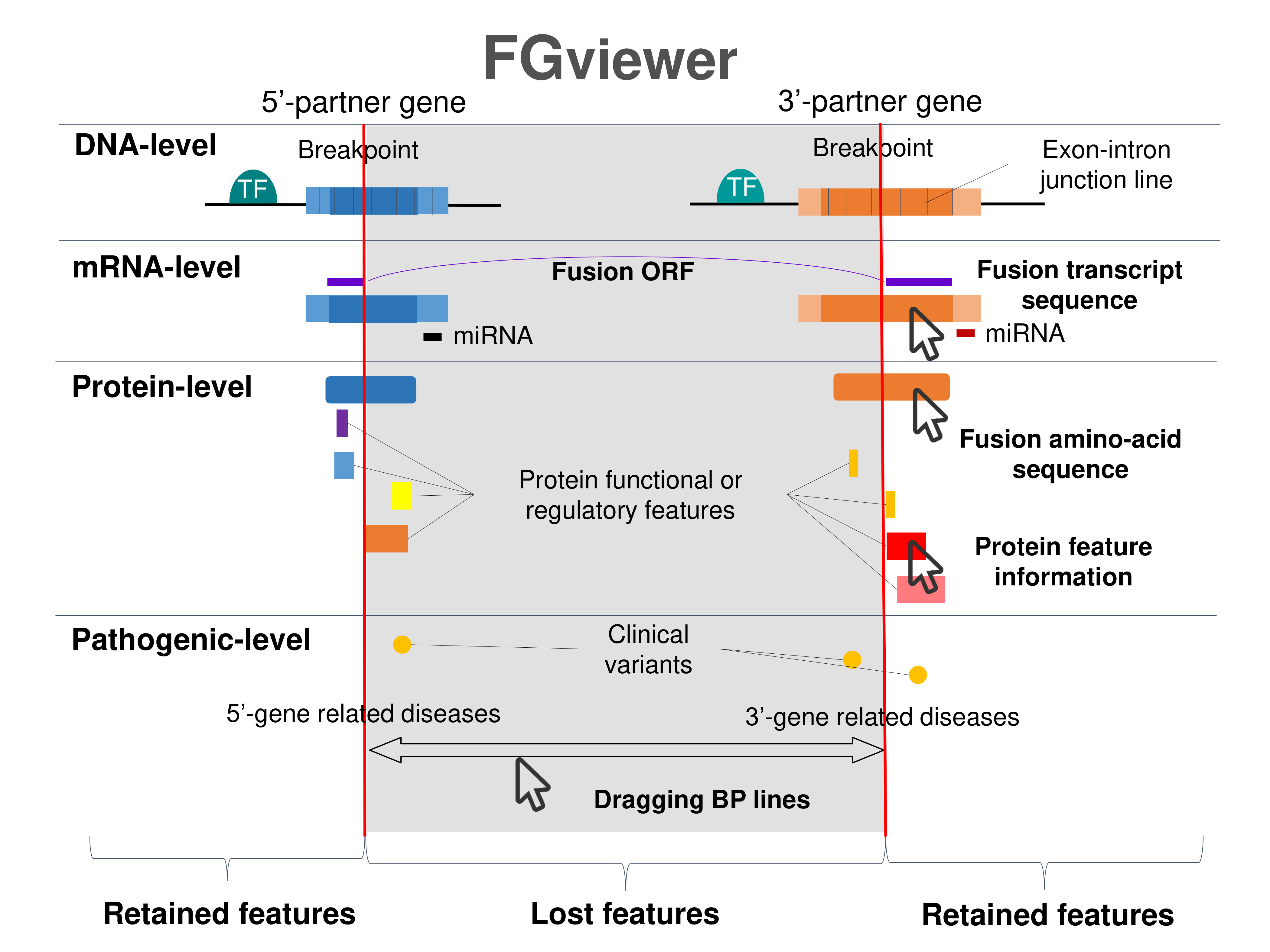
| Four levels of functional features of fusion genes Go to FGviewer search page for the most frequent breakpoint (https://ccsmweb.uth.edu/FGviewer/:34415602/:10818876) - FGviewer provides the online visualization of the retention search of the protein functional features across DNA, RNA, protein, and pathological levels. - How to search 1. Put your fusion gene symbol. 2. Press the tab key until there will be shown the breakpoint information filled. 4. Go down and press 'Search' tab twice. 4. Go down to have the hyperlink of the search result. 5. Click the hyperlink. 6. See the FGviewer result for your fusion gene. |
 |
| Main function of each fusion partner protein. (from UniProt) |
| Hgene | Tgene |
| . | MAK |
| FUNCTION: Transcriptional activator which is required for calcium-dependent dendritic growth and branching in cortical neurons. Recruits CREB-binding protein (CREBBP) to nuclear bodies. Component of the CREST-BRG1 complex, a multiprotein complex that regulates promoter activation by orchestrating a calcium-dependent release of a repressor complex and a recruitment of an activator complex. In resting neurons, transcription of the c-FOS promoter is inhibited by BRG1-dependent recruitment of a phospho-RB1-HDAC1 repressor complex. Upon calcium influx, RB1 is dephosphorylated by calcineurin, which leads to release of the repressor complex. At the same time, there is increased recruitment of CREBBP to the promoter by a CREST-dependent mechanism, which leads to transcriptional activation. The CREST-BRG1 complex also binds to the NR2B promoter, and activity-dependent induction of NR2B expression involves a release of HDAC1 and recruitment of CREBBP (By similarity). {ECO:0000250}. | FUNCTION: Essential for the regulation of ciliary length and required for the long-term survival of photoreceptors (By similarity). Phosphorylates FZR1 in a cell cycle-dependent manner. Plays a role in the transcriptional coactivation of AR. Could play an important function in spermatogenesis. May play a role in chromosomal stability in prostate cancer cells. {ECO:0000250, ECO:0000269|PubMed:12084720, ECO:0000269|PubMed:16951154, ECO:0000269|PubMed:21986944}. |
| Retention analysis result of each fusion partner protein across 39 protein features of UniProt such as six molecule processing features, 13 region features, four site features, six amino acid modification features, two natural variation features, five experimental info features, and 3 secondary structure features. Here, because of limited space for viewing, we only show the protein feature retention information belong to the 13 regional features. All retention annotation result can be downloaded at * Minus value of BPloci means that the break pointn is located before the CDS. |
| - In-frame and retained protein feature among the 13 regional features. |
| Partner | Gene | Hbp | Tbp | ENST | Strand | BPexon | TotalExon | Protein feature loci | *BPloci | TotalLen | Protein feature | Protein feature note |
| - In-frame and not-retained protein feature among the 13 regional features. |
| Partner | Gene | Hbp | Tbp | ENST | Strand | BPexon | TotalExon | Protein feature loci | *BPloci | TotalLen | Protein feature | Protein feature note |
Top |
Fusion Gene Sequence for CCL3-MAK |
| For in-frame fusion transcripts, we provide the fusion transcript sequences and fusion amino acid sequences. To have fusion amino acid sequence, we ran ORFfinder and chose the longest ORF among the all predicted ones. |
Top |
Fusion Gene PPI Analysis for CCL3-MAK |
| Go to ChiPPI (Chimeric Protein-Protein interactions) to see the chimeric PPI interaction in |
| Protein-protein interactors with each fusion partner protein in wild-type (BIOGRID-3.4.160) |
| Hgene | Hgene's interactors | Tgene | Tgene's interactors |
| - Retained PPIs in in-frame fusion. |
| Partner | Gene | Hbp | Tbp | ENST | Strand | BPexon | TotalExon | Protein feature loci | *BPloci | TotalLen | Still interaction with |
| - Lost PPIs in in-frame fusion. |
| Partner | Gene | Hbp | Tbp | ENST | Strand | BPexon | TotalExon | Protein feature loci | *BPloci | TotalLen | Interaction lost with |
| - Retained PPIs, but lost function due to frame-shift fusion. |
| Partner | Gene | Hbp | Tbp | ENST | Strand | BPexon | TotalExon | Protein feature loci | *BPloci | TotalLen | Interaction lost with |
Top |
Related Drugs for CCL3-MAK |
| Drugs targeting genes involved in this fusion gene. (DrugBank Version 5.1.8 2021-05-08) |
| Partner | Gene | UniProtAcc | DrugBank ID | Drug name | Drug activity | Drug type | Drug status |
Top |
Related Diseases for CCL3-MAK |
| Diseases associated with fusion partners. (DisGeNet 4.0) |
| Partner | Gene | Disease ID | Disease name | # pubmeds | Source |
| Hgene | CCL3 | C0007786 | Brain Ischemia | 2 | CTD_human |
| Hgene | CCL3 | C0020517 | Hypersensitivity | 2 | CTD_human |
| Hgene | CCL3 | C0034069 | Pulmonary Fibrosis | 2 | CTD_human |
| Hgene | CCL3 | C0917798 | Cerebral Ischemia | 2 | CTD_human |
| Hgene | CCL3 | C1527304 | Allergic Reaction | 2 | CTD_human |
| Hgene | CCL3 | C4721507 | Alveolitis, Fibrosing | 2 | CTD_human |
| Hgene | CCL3 | C0004153 | Atherosclerosis | 1 | CTD_human |
| Hgene | CCL3 | C0017658 | Glomerulonephritis | 1 | CTD_human |
| Hgene | CCL3 | C0021368 | Inflammation | 1 | CTD_human |
| Hgene | CCL3 | C0035126 | Reperfusion Injury | 1 | CTD_human |
| Hgene | CCL3 | C0038220 | Status Epilepticus | 1 | CTD_human |
| Hgene | CCL3 | C0151744 | Myocardial Ischemia | 1 | CTD_human |
| Hgene | CCL3 | C0270823 | Petit mal status | 1 | CTD_human |
| Hgene | CCL3 | C0273115 | Lung Injury | 1 | CTD_human |
| Hgene | CCL3 | C0311335 | Grand Mal Status Epilepticus | 1 | CTD_human |
| Hgene | CCL3 | C0345967 | Malignant mesothelioma | 1 | CTD_human |
| Hgene | CCL3 | C0393734 | Complex Partial Status Epilepticus | 1 | CTD_human |
| Hgene | CCL3 | C0751522 | Status Epilepticus, Subclinical | 1 | CTD_human |
| Hgene | CCL3 | C0751523 | Non-Convulsive Status Epilepticus | 1 | CTD_human |
| Hgene | CCL3 | C0751524 | Simple Partial Status Epilepticus | 1 | CTD_human |
| Hgene | CCL3 | C1563937 | Atherogenesis | 1 | CTD_human |
| Hgene | CCL3 | C1704377 | Bright Disease | 1 | CTD_human |
| Hgene | CCL3 | C2239176 | Liver carcinoma | 1 | CTD_human |
| Hgene | CCL3 | C2350344 | Chronic Lung Injury | 1 | CTD_human |
| Tgene | C3280042 | RETINITIS PIGMENTOSA 62 | 3 | CTD_human;GENOMICS_ENGLAND;UNIPROT | |
| Tgene | C0015397 | Disorder of eye | 1 | GENOMICS_ENGLAND | |
| Tgene | C0035334 | Retinitis Pigmentosa | 1 | GENOMICS_ENGLAND |
 Copyright 2021-Present -The University of Texas Health Science Center at Houston
 (UTHealth)
Web File Viewing | Emergency Information |Campus Carry|Site Policies